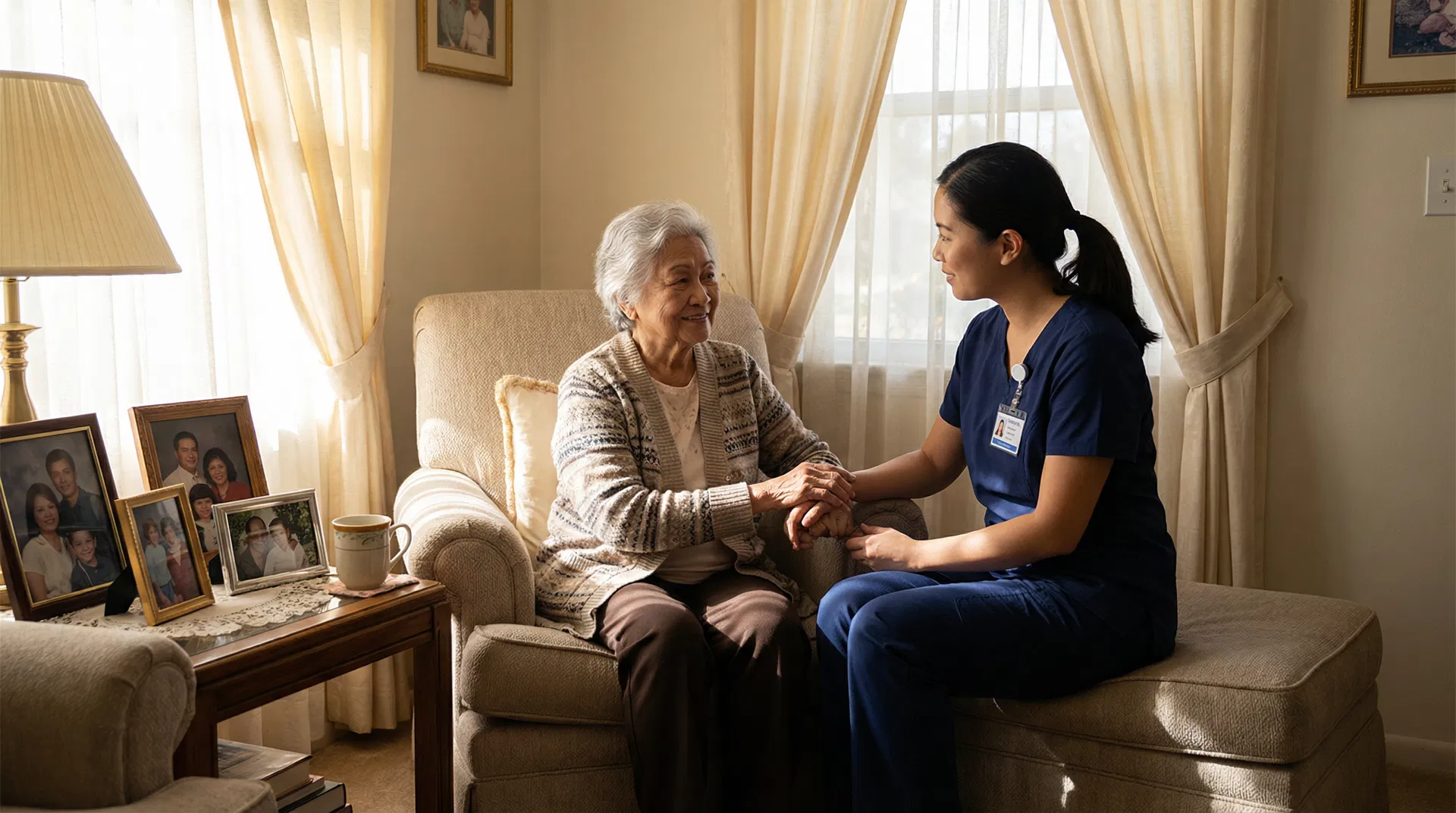
Maria's Journey: From Hospital to Home
How our nurse-led team delivered compassionate, preventative care that kept an 85-year-old client safely at home — with zero hospital readmissions.
6 Days
Assessment to Care Start
22 Pages
Comprehensive Care Plan
0
Hospital Readmissions
6 Weeks
Formal Review Cycle
An Urgent Need for Expert Care After a Hospital Admission
Maria*, an 85-year-old woman originally from the Philippines, was admitted to hospital by ambulance after a fall at home — possibly with a prolonged period on the floor. She was accompanied by her daughter, Audrey*, and son-in-law.
At the hospital, Maria presented with active delirium — she described seeing a baby at the foot of her bed and believed she was back in her village, referring to hospital staff as members of that community. She was clearly confused and disoriented, and at one point attempted to enter the men's ward, highlighting her vulnerability.
There were concerns about a possible stroke, though imaging was inconclusive. Maria was assessed as mildly frail (Rockwood Frailty Scale score of 5) and at risk of further falls, wandering, ongoing delirium, dehydration, and physical and mental deterioration.
Audrey was understandably worried about her mother's safety at home. She needed a care provider she could trust — one that could act quickly, assess thoroughly, and deliver compassionate, clinically informed support.
*Names have been changed to protect client privacy.

Our registered nurse conducted the initial assessment at the hospital bedside — the same evening the family called.
What Made the DHS Approach Different
This was not a tick-box exercise. Every decision was clinically informed, person-centred, and driven by genuine compassion.
Nurse-Led Assessment
A registered nurse — not a coordinator — conducted the face-to-face assessment at the hospital bedside. Clinical expertise from the very first contact ensured nothing was missed.
Same-Day Response
The assessment was carried out at 7:00 PM on the same day the family reached out. We do not wait for office hours when families need help.
Compassionate Carers
Our carers were briefed on Maria's delirium, cultural background, and communication needs. They were guided to speak slowly, use short sentences, and engage on topics of her choice.
22-Page Bespoke Care Plan
A comprehensive care plan covering every domain — written in Maria's own voice using first-person language to honour her dignity and preferences.
Watchful Documentation
Daily care logs, medication records, skin integrity checks, and behavioural observations. Every change was documented and escalated — preventing the need for hospital readmission.
Family Transparency
Weekly updates to Audrey, open communication channels, and a formal 6-week review. The family was never left wondering about their mother's care.
From First Call to Formal Review
A timeline of how we moved swiftly and thoroughly to ensure Maria's safety, dignity, and recovery.
Hospital Bedside Assessment
Our registered nurse conducted a face-to-face assessment at the hospital at 7:00 PM — the same day the family reached out. The nurse evaluated Maria's mental state, functional abilities, risk factors, and social history, engaging directly with both Maria and her daughter.
Bespoke Care Plan Created
Within 5 days, our clinical team produced a comprehensive 22-page care plan covering every domain — communication, mobility, medication, personal care, skin integrity, nutrition, mental health, daily activities, and environmental safety. Written in first person to honour Maria's voice.
Care Commenced at Home
24-hour live-in care began at Maria's bungalow. A dedicated carer was matched to her needs, with the first week focused on understanding her routines, preferences, and responses to support in her own environment.
Ongoing Monitoring & Prevention
Weekly family updates, daily care logs, medication supervision, falls prevention measures, delirium monitoring, and meaningful daily activities. Our nurse-led oversight ensured early detection of any changes in Maria's condition — preventing hospital readmission.
Formal Care Review
A structured 21-section care review assessed every aspect of Maria's wellbeing — from cognition and mobility to safeguarding and community access. The review confirmed improvement in delirium symptoms and successful prevention of further falls.
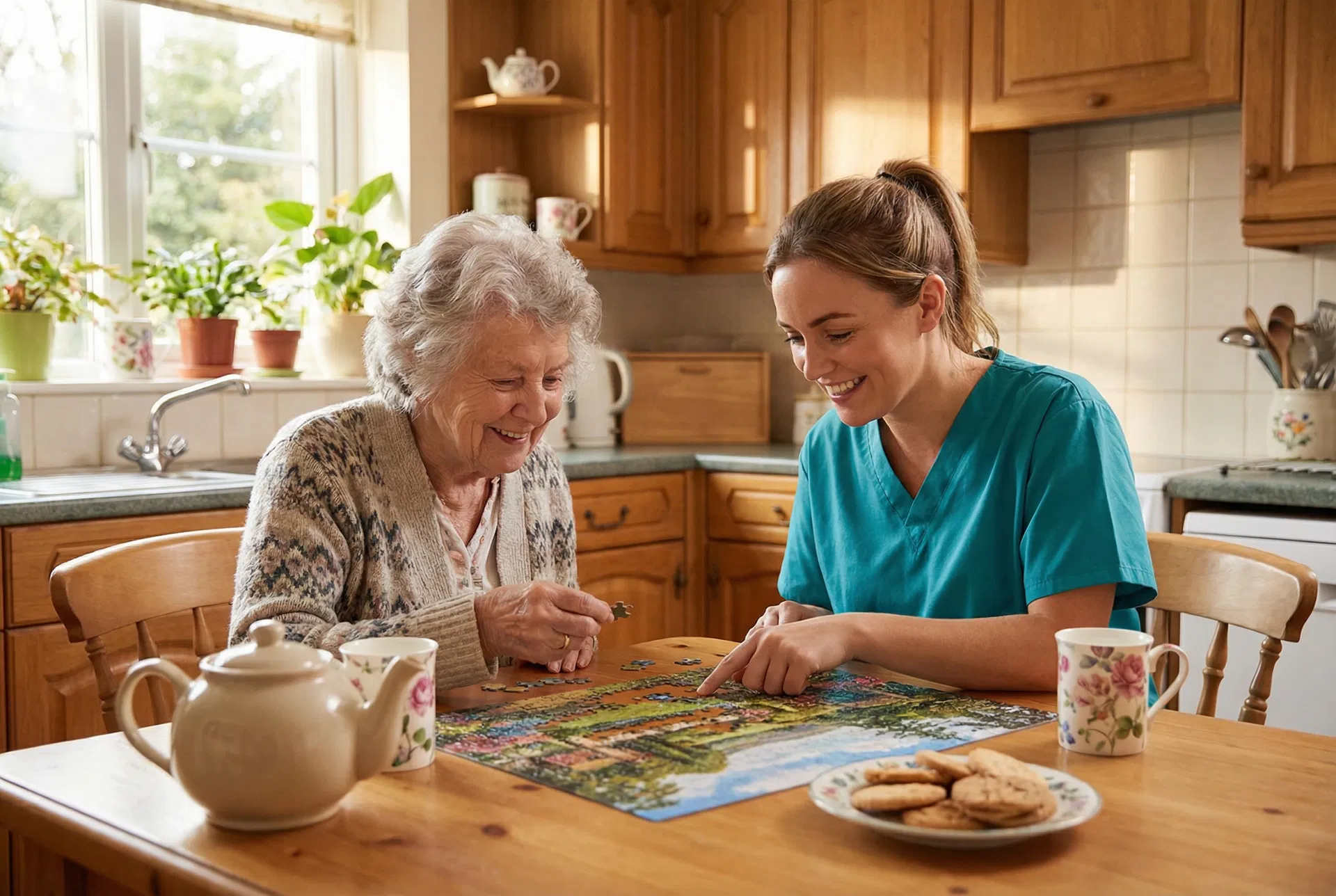
Meaningful daily activities — from puzzles to conversation — support cognitive recovery and emotional wellbeing.
How Watchful Care Prevented Hospital Readmission
Maria's care plan included a 5-level prompting threshold system — from no prompting when she was managing independently, through verbal prompting, supervision, hands-on assistance, and escalation. This graduated approach preserved her independence while ensuring safety.
Our carers monitored Maria's delirium symptoms daily, documenting any hallucinations, confusion, or behavioural changes. Medication administration was supervised and recorded, with any missed doses or signs of non-compliance escalated immediately.
Falls prevention measures included environmental safety checks, appropriate footwear, gentle strengthening activities, and constant supervision during mobility. Skin integrity was monitored daily, with any concerns documented and reported to the family.
The result: zero falls, zero hospital readmissions, and a steady improvement in Maria's cognitive state — all confirmed at the formal 6-week care review.
Client Outcomes
Measurable results that demonstrate the impact of our approach.
Zero Hospital Readmissions
Watchful care and daily documentation prevented the need for emergency hospital visits
Delirium Resolution
Close monitoring and familiar environment supported cognitive recovery
No Further Falls
Environmental safety checks and supervision eliminated fall risk
Family Peace of Mind
Weekly updates and transparent reporting kept the family informed and reassured
Independence Maintained
Graduated support thresholds preserved Maria's autonomy and dignity
Formal Review on Schedule
Structured 6-week review confirmed care plan objectives were being met
Documentation You Can Trust
Every aspect of Maria's care was documented in real time. Our daily care logs captured medication administration, nutritional intake, fluid monitoring, skin integrity observations, mobility support, and behavioural notes — creating a complete clinical picture that could be shared with the family and healthcare professionals at any time.
The formal 6-week care review was a structured, 21-section assessment covering every domain of Maria's wellbeing — from cognition and mobility to safeguarding and community access. Each section was evaluated against clear criteria: improving, stable, fluctuating, or deteriorating.
This level of documentation is not just good practice — it is what prevented Maria from being readmitted to hospital. When you can see the early signs of change, you can act before a crisis occurs.
What Our Care Plan Covered

"Our overarching aim is to ensure Maria's safety, dignity, and wellbeing while supporting her recovery, independence, and quality of life — and to provide her family with reassurance and confidence in the care being delivered."
Dairai Sylvester Mandisodza
Director, Divine Health Services
This Is The Divine Standard
Maria's story is not an exception — it is the standard. Every client receives the same nurse-led assessment, the same comprehensive care planning, the same transparent reporting, and the same compassionate, preventative approach. We call it The Divine Standard.